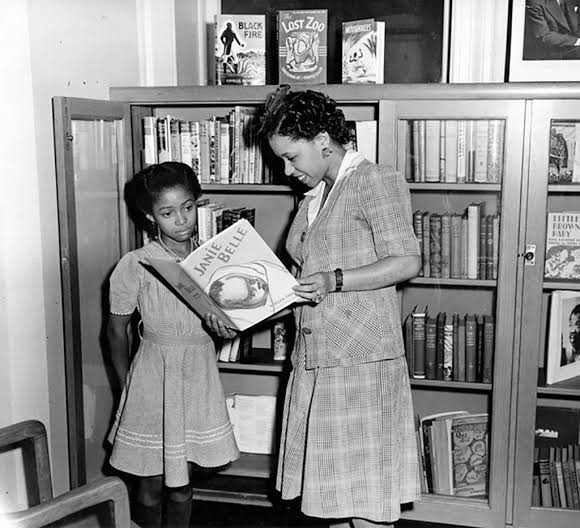
Featured Image: Photo of Augusta Braxton Baker (1911–1998), the first African American woman to hold an administrative position at the New York Public Library. Baker was a trailblazer in children’s literature who advocated for positive Black representation and helped remove harmful stereotypes from library shelves beginning in the 1930s. Information adapted from BlackPast.org.
While I was substitute teaching, one of the biggest questions I got was: “Are you in college? What do you want to do after you graduate?”
I’d tell them, “I’m getting my Master’s Degree in Library and Information Science so I can become a librarian.”
And nine times out of ten, their response was always the same:
“You want to be surrounded by books?! I hate reading!”
And as I reflect on that, I remember my why.
Growing up, books were a magical escape for me whenever I was bored, wanted to be somewhere else, or simply needed space for my imagination to thrive. Books allowed me to travel to places I’d never been, meet people I’d never met, and most importantly, feel seen.
From Junie B. Jones, Magic Tree House, Dork Diaries, to the To All The Boys I’ve Loved Before series, I’ve resonated with so many characters growing up. Being able to see yourself well represented in books is life-changing. It saddens me to hear so many kids express disdain for reading.
Even you, the person reading this right now, may feel like you’re “just not a book person.” But I truly believe books are for everyone; you just haven’t found your niche yet. Reading doesn’t have to be limited to self-help or educational books. Books are fun! There are romance novels, fantasy worlds, mysteries, thrillers, and truly something for everyone.
I feel so passionate about fostering a love of reading in children, and that’s exactly why my goal is to become a children’s librarian. Books are incredibly important and transformative during those adolescent years, and we need more people advocating for children and giving them access to books.
Libraries matter because they provide access. Not every child or family can afford to shop at bookstores, but libraries allow people to access millions of books for free. That’s why it’s so important to support and advocate for our local libraries so they can remain open and accessible to low-income families and all families alike.
Going to the library as a child felt magical to me. The summer reading program was my favorite time of year. I loved attending events and picking up reading lists for the summer. It brought me so much joy, and I’m excited for the day when I’ll get to create programs and events that make children excited about reading again.
I decided not only to pursue my Master of Library and Information Science degree, but also a Youth Services and Literature Certificate because I want to learn how to serve young patrons well and help connect them with stories that reflect their lives and experiences.
One of the most important aspects of being a librarian is providing access to books that may not always align with your own personal beliefs or experiences because, at the end of the day, libraries exist to serve everyone. Our responsibility is to connect patrons with stories and information that matters to them.
My goal is to become so well-read that I can recommend a book just based on someone telling me their interests. Becoming a librarian has taught me that I can’t only read books that match my personal tastes. Reader’s Advisory is about exploring diverse genres, perspectives, and stories so I can better help others find books they’ll truly connect with.
Lord willing, I’ll be graduating this December, and I’m currently working on my capstone proposal. My research focuses on whether public library websites provide resources that help parents and caregivers navigate appropriate screen time for children and support early literacy development before children enter school.
I’m passionate about this topic because studies show that children who are read to before starting school often perform better academically throughout their educational journey. Research also shows that low-income parents are less likely to read to their children. They also are less likely to have access to educational materials and literacy resources that support early childhood learning, and too much screen time can also interfere with this.
Libraries are uniquely positioned to help address these issues because they provide free access to books, educational materials, and community resources, not only in person, but online as well, for families who may not be able to physically visit the library.
I also want to talk about being black in the library space.
According to the Morgan Library and Museum:
Librarianship in the United States has always been a predominately white profession. Even today, despite visible efforts to increase diversity and inclusivity within the profession, including having a Black woman as the executive director of the American Library Association and a Black woman as the fourteenth Librarian of Congress, 82 percent of librarians in the United States identify as white. American libraries have a fraught racial past. Not only has the profession been an extremely difficult one for people of color to enter, significant obstacles have prevented Black people from accessing libraries—public and private—as patrons. In fact, one of the very first sit-in demonstrations in the United States was held for the purpose of integrating a public library.
I see this reflected in my own experiences, in the libraries in my state, and even in my classes. I currently have no black professors and only a handful of black classmates. In my town, there are currently no black people on staff at the library. When I previously worked at a library in Southaven, MS, I was the only black staff member.
If librarianship is truly about providing access to diverse stories and perspectives, then diversity within the profession matters deeply. We all carry implicit biases, which is why it’s important to have people of different races, ages, cultures, and backgrounds helping shape library collections and services in our communities.
I can go on and on all day about this but ultimately I want my main point to remain clear:
Reading is for everyone.
Everyone deserves free access to books, and it’s a privilege that we still have free spaces like libraries within our communities. Let’s support them, use them, and advocate for them before we see them disappear. Please support your local library and get a library card!!
Thank you so much for reading.
Kindly,
Kayla ♡
References:
Garner, C. (2010, September 8). Augusta Braxston Baker (1911-1998) . BLACKPAST. https://blackpast.org/african-american-history/baker-augusta-braxston-1911-1998/
Publications Department. (2024, November 12). Black librarianship and the legacy of Belle da Costa Greene. Black Librarianship and the Legacy of Belle da Costa Greene | The Morgan Library & Museum. https://www.themorgan.org/blog/black-librarianship-and-legacy-belle-da-costa-greene
 Kindly, Kayla 🌼
Leave a comment